2026 McDonald-Dunn Forest Harvest Details

Planned harvests on the McDonald-Dunn for the 2026 season
The upcoming harvests on the McDonald-Dunn are guided by the recently adopted 2025 McDonald-Dunn Forest Plan. The plan establishes an adaptive framework for stewardship in a changing climate and reinforces the forest’s role as an actively managed, financially self-supporting landscape balancing research, education, ecological resilience, sustainable wood production and public access. The McDonald-Dunn Forest is the most heavily visited forest in OSU's statewide network of 10 research forests and a primary site for student training and applied research. Students participate in harvest planning, field layout and monitoring as part of their coursework and professional preparation.
Five units are scheduled for harvest on the McDonald-Dunn as part of the 2026 harvest plan, impacting approximately 261 of the forest’s 11,500 acres (about 2.3% of the landscape). The projected harvest volume is approximately 4.17 million board feet, below the 4.3 million board feet annual level established in the 2025 Plan.
Across the five units:
- 155 acres will be thinned
- 104 acres will be managed through regeneration or group selection harvests with structural and/or visual retention
- 2 acres will focus on oak release
- 3 acres will focus on meadow restoration
- 7 acres are reserved to protect mature forest ecosystems
- 10 acres are designated as visual buffers near popular recreation areas
Note: Most of the forest will remain open during operations. Temporary trail or road closures may occur for safety and to accommodate operations including log hauling.
Click on the harvest units, trails, and kiosks in the interactive harvest map at the bottom of this page to see access impacts for each location.
Individual harvest details
All of the planned treatments support the objectives of establishing new age classes, diversifying forest structure and improving long-term resilience while remaining within the reduced harvest levels established in the 2025 plan. Specifics of the planned harvests can be viewed by expanding the drop-downs below.
Gentle Giant falls under the Multi-Aged Multi-Species strategy in the 2025 McDonald-Dunn Forest Plan. A variety of harvest approaches will occur within the 150-acre project area, primarily thinning (112 acres), along with 36 acres of group selection harvests. These treatments will begin transitioning a Douglas-fir stand containing trees approximately 105-130 years old, shaped by earlier management that favored uniform age classes, toward a more diverse mix of tree ages, species and forest structures as the forest is gradually aligned with the new strategies outlined in the 2025 plan.

Each stand managed under this strategy will be stewarded to create heterogeneity through retention of individual trees, clumps of trees, and no touch areas. Periodic thinning will maintain appropriate stand densities, and enhance forest structure, composition, and growth rates. Variable retention harvest may occur at age 60-120 years.
The stand is experiencing notable Douglas-fir mortality. Thinning will address existing mortality and reduce competition for light, water and nutrients, supporting the growth of remaining trees. Larger and older Douglas-fir, along with Pacific madrone, bigleaf maple and Oregon white oak, will be retained within the unit. Within the patch cuts, structural retention averages approximately 8.7 wildlife trees per acre, maintaining habitat features as new age classes establish.
The unit also includes significant exclusions and buffers. Seven acres are excluded from harvest to protect mature forest ecosystems, and 10 acres are reserved to provide recreation and visual buffers along trails and roads. Gentle Giant also overlaps an active landslide research and monitoring site led by College of Forestry faculty Ben Leshchinsky and Annette Patton, where pre- and post-harvest monitoring will evaluate how retention strategies influence slope stability and soil conditions.
Due to the location and scale of this harvest, recreational forest users should expect temporary closures along the 600 road to safely accommodate operations and log hauling.
Pinchot is part of the Even-Aged Long Rotation strategy identified in the 2025 McDonald-Dunn Forest Plan. The unit includes a 23.5-acre regeneration harvest with structural retention in a 72-year-old stand adjacent to private forestland that was recently harvested. The project will retain 227 wildlife trees — about 9.6 trees per acre — including bigleaf maple, Douglas-fir and Oregon white oak.

Each stand managed under this strategy will pass through 6 stand development stages before being harvested, with one thinning around 30 years, and potentially more later. Harvests will occur at age 60-90 years for 97% of stands and up to 120 years for the remaining 3%.
Within the southern portion of the project area is Butterfly Meadow, a previously restored opening where Douglas-fir has begun to encroach in recent years, reducing light and limiting habitat conditions for native species. The restoration was a joint effort between the U.S. Fish and Wildlife Service and the Sustainable Forestry Initiative. This portion of the harvest — aligned with the 2025 plan’s Ecosystems of Concern strategy — will improve conditions for Fender’s blue butterfly and Kincaid’s lupine, which depend on open prairie habitat.
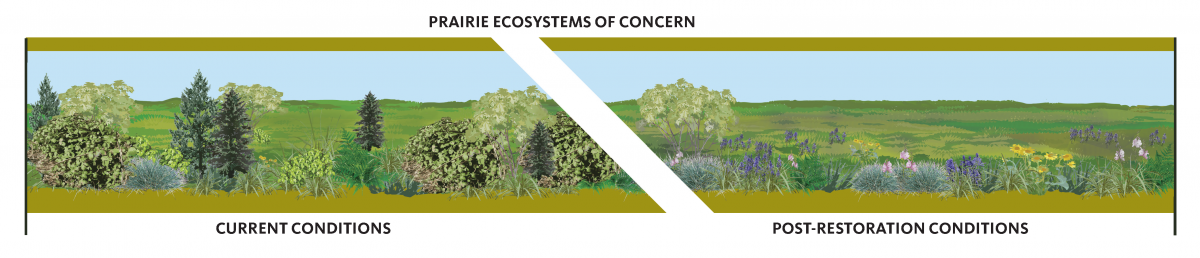
Each area is stewarded to halt encroachment of conifers and woody shrubs, and enhance grass and herbaceous species native to prairies.
The meadow has also served as a site for ecological monitoring by OSU researchers and partner organizations, including the U.S. Forest Service and the Institute for Applied Ecology, and expanding the meadow provides an opportunity for renewed surveys and habitat assessment following harvest. The last known population survey at the site occurred in 1999.
Following harvest, the forest portion of the unit will be replanted with appropriate site-specific seedlings, while maintaining the expanded meadow area and avoiding encroachment into restored habitat.
Southside is part of the Even-Aged Long Rotation strategy identified in the 2025 McDonald-Dunn Forest Plan. The project includes a 35.7-acre harvest with structural retention in a 64-year-old even-aged stand established under earlier management approaches that favored uniform Douglas-fir plantations.
Each stand managed under this strategy will pass through 6 stand development stages before being harvested, with one thinning around 30 years, and potentially more later. Harvests will occur at age 60-90 years for 97% of stands and up to 120 years for the remaining 3%.
Regeneration harvests in stands like this help maintain a diversity of age classes across the McDonald-Dunn landscape — an important component of long-term forest resilience and sustainability. The renewable wood products generated also support the research forests’ financial self-sufficiency, funding ongoing research, education and public access.
The harvest will retain approximately 4.5 wildlife trees per acre, including bigleaf maple, Douglas-fir, Oregon white oak, Pacific madrone, grand fir and red alder. These retained trees provide habitat features and structural diversity as the next stand develops.
In addition to replanting, post-harvest activity will include the removal of an unauthorized mountain bike trail within the unit boundary. Removing unauthorized trails reduces safety risks and limits soil disturbance, erosion and other impacts that can affect forest health and management operations.
Borderlands falls under the Multi-Aged Multi-Species strategy in the 2025 McDonald-Dunn Forest Plan. The project includes an 8.7-acre regeneration harvest with structural retention in a 51-year-old stand.

Each stand managed under this strategy will be stewarded to create heterogeneity by creating small openings that regenerate new age classes of trees. Final harvest will occur at age 60-120 years.
The unit borders recently harvested private forestland and has experienced significant windthrow and blowdown, conditions that are likely to continue due to the stand’s exposure and surrounding younger forest conditions. This project will remove damaged and unstable trees and allow the site to be replanted, establishing the next generation of forest.
As with other regeneration harvests in the forest, structural retention will maintain habitat features within the harvest area while a new stand develops.
This 43.2-acre thinning project is located within the College of Forestry Integrated Research Project (“CFIRP”) site, which studies ecological and socioeconomic responses to alternative silvicultural treatments. The thinning will remove suppressed and damaged trees, providing remaining trees greater access to light, water and nutrients and allowing them more room to continue growing in both diameter and height.
This project is being implemented by the College of Forestry’s Student Logging Training Program, providing students with hands-on experience in harvest layout, timber falling, yarding and other operational aspects of forest management while working within an active research site. The program prepares students for careers in forest operations and management by providing real-world experience conducting harvest work in working research forests.
In addition to the five planned projects outlined above, a forest-wide salvage operation will take place to remove trees downed or damaged during a significant windstorm in December 2025. The salvage harvest will recover value, reduce safety hazards and limit future fuel accumulation. As an unplanned response to storm damage, total salvage volume will not be known until operations are complete. Salvage volume is not calculated as part of the planned annual harvest target, but is incorporated into harvest volumes averaged over a five-year period.
There are also two harvest units — Fat Cat and Mori — originally contracted as part of the 2025 harvest plan but postponed due to economic conditions. The acreage and timber volume for these harvests were accounted for in the year they were originally scheduled and are therefore not included in the 2026 harvest acreage or volume totals. These projects are included in the interactive harvest map below because they may temporarily affect recreational access and operations. The Fat Cat harvest is currently underway, while Mori has not yet been rescheduled but will be completed prior to the conclusion of the 2027 harvest season.
 Zoom in & out
  My Location
  Print
Print  Basemap Gallery
  Legend
Last updated: 08/10/2026