McDonald-Dunn Research Forest Planning Process

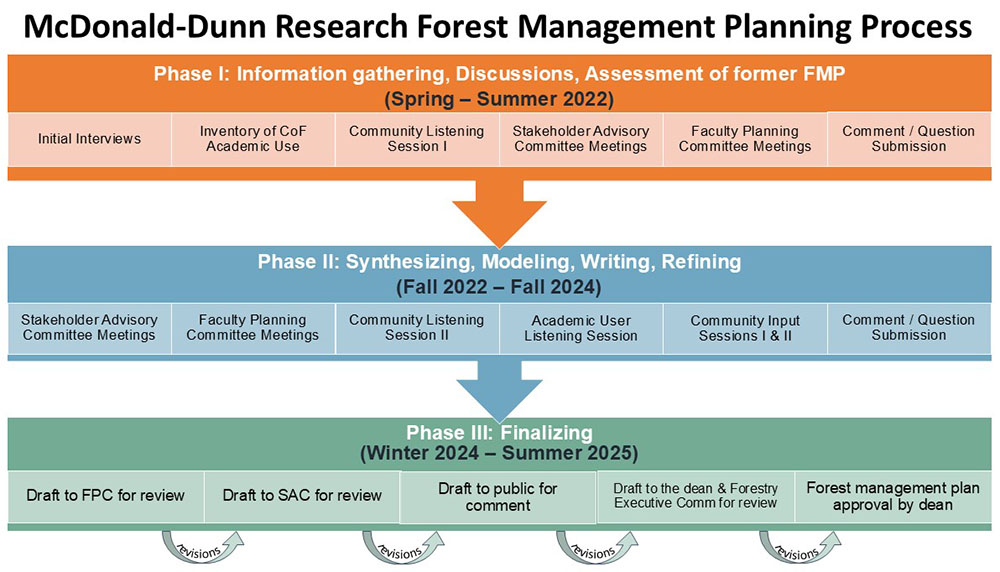
In 2020, shortly after being appointed dean of the College of Forestry, Tom DeLuca established a Research Forest Advisory Committee within the college and charged it with drafting updated vision, mission and goals for the OSU Research Forests. The committee was also charged with recommending a process for developing new management plans across all research forests tracts, prioritizing the McDonald-Dunn Research Forest, and participating in and/or advising on a planning process — including external stakeholder involvement — to update the McDonald-Dunn Forest Plan for the dean’s approval.
Based on the advisory committee's recommendations, the college moved forward with a collaborative planning process for the McDonald-Dunn Forest that involved the establishment of two committees, comprised of 23 individuals total, to provide input throughout the planning process. One group, the Stakeholder Advisory Committee (SAC) was made up of individuals external to the university with representation from Tribal natural resource managers, state and local agencies, NGOs, private industry, and forest neighbors, and another group, the Faculty Planning Committee (FPC), had representation from five academic departments across OSU, providing expertise on all aspects of forest management. Research forest staff were not members of the SAC or FPC, but are involved in discussions as needed, as technical resources. They served in an ex-officio capacity.
The process of developing the new management plan also involved opportunities for public input. In partnership with Oregon Consensus, the College of Forestry hosted two community listening sessions to gather information on aspirations and concerns of forest users early in the planning process and two community input sessions to gather input on forest land allocation decisions late in the planning process. Once a draft plan was developed, the college also provided the public with the opportunity to review the plan and provide input during a 30-day public comment period in June 2025. More than 130 individuals and organizations — including community members, students, faculty, alumni, industry professionals, nonprofits and professional associations — submitted comments reflecting a wide range of perspectives and values, with the full text of the comments posted online.
The draft plan was also reviewed by the College of Forestry's Forestry Executive Committee to provide input on whether the draft plan fulfilled the dean’s original charge for developing the plan, and whether it met the objectives outlined in the research forests’ vision, mission and goals developed by the Research Forest Advisory Committee.
Based on the feedback received, the college then completed additional modeling, using adjusted parameters to confirm the optimal harvest age for stands managed under the even-aged, short-rotation strategy, and to validate other underlying assumptions in the draft plan. It also revised the plan to clarify the need for continued active management, refine technical elements, and establish a new advisory group to assess future revenue-generating opportunities.
With these modifications incorporated, the dean approved the plan for implementation beginning in Jan. 2026. The final plan is available here.
A summary of the planning process can be found below, including recordings and materials for each of the planning committees’ meetings, as well as the public input sessions.
Past Meetings & Events
Stakeholder Advisory Committee (SAC): This committee engaged a broad and diverse array of voices and perspectives in the planning process. The primary role of the SAC was to provide recommendations regarding the balance of forest uses, values and management practices and to help ensure that broader stakeholder and public input was understood and reflected. SAC members were asked to share concerns and aspirations regarding management of the forests, ensuring community expectations were understood by College of Forestry leaders and incorporated into the alternative scenarios evaluated during the planning process. The SAC was not a decision-making body, but worked in tandem with the FPC to inform the development of a new management plan that was ultimately reviewed by the College of Forestry's Forestry Executive Committee and approved by the dean.
- May 20, 2025, Joint SAC and FPC meeting (agenda, presentation, video recording)
- Oct. 24, 2024, SAC Meeting (agenda, presentation, video recording)
- Sept 25, 2024, SAC Meeting (agenda, presentation, video recording)
- June 3, 2024, SAC Meeting (agenda, presentation, video recording)
- Jan. 30, 2024, SAC Meeting (agenda, presentation)
- Apr. 13, 2023, SAC Meeting (agenda, presentation 1, presentation 2, video recording, meeting summary)
- Mar. 27, 2023, SAC and FPC Joint Field Tour
- Mar. 1, 2023, SAC Meeting (agenda, presentation, video recording, meeting summary)
- Feb. 25, 2023, SAC and FPC Joint Field Tour
- Jan. 18, 2023, SAC Meeting (agenda, presentation, video recording, meeting summary)
- Dec. 13, 2022, SAC Meeting (agenda, video recording, meeting summary)
- Dec. 5, 2022, SAC Meeting (agenda, presentation, video recording, meeting summary)
- Sept. 20, 2022, SAC Meeting (agenda, presentation, video recording, meeting summary)
- Aug 30, 2022, SAC Meeting (agenda, presentation, meeting summary)
- June 14, 2022, SAC and FPC Joint Kickoff Meeting (agenda, video, meeting summary)
Faculty Planning Committee (FPC): This committee provided technical input related to the forest management plan. Members helped develop the new plan, independently assessed modeled management scenarios, reviewed portions of the draft plan, contributed to the evaluation of public input during the planning process, and provided input on implementation approaches and communication strategies to support long-term engagement and accountability.
- May 20, 2025, Joint SAC and FPC meeting (agenda, presentation, video recording)
- Nov. 19, 2024, FPC Meeting (agenda, presentation, video recording)
- Nov. 4, 2024, FPC Meeting (agenda, presentation, video recording, meeting summary)
- Oct. 18, 2024, FPC Meeting (agenda, presentation, video recording, meeting summary)
- Oct. 3, 2024, FPC Meeting (agenda, presentation, video recording, meeting summary)
- Sept 16, 2024, FPC Meeting (agenda, presentation, video recording, meeting summary)
- May 30, 2024, FPC Meeting (agenda, presentation, video recording, meeting summary)
- Feb. 22, 2024, FPC Meeting (agenda, presentation, video recording, meeting summary)
- Jan. 25, 2024, FPC Meeting (agenda, presentation, video recording, meeting summary)
- Dec. 12, 2023, FPC meeting (agenda, presentation, video recording, meeting summary)
- Nov. 28, 2023, FPC meeting (agenda, presentation, video recording, meeting summary)
- Nov. 14, 2023, FPC meeting (agenda, presentation, video recording, meeting summary)
- Oct. 31, 2023, FPC meeting (agenda, presentation, video recording, meeting summary)
- Oct. 17, 2023, FPC meeting (agenda, presentation, video recording, meeting summary)
- June 12, 2023, FPC Meeting (agenda, presentation, video recording, meeting summary)
- May 1, 2023, FPC Meeting (agenda, presentation, video recording, meeting summary)
- Apr. 17, 2023, FPC Meeting (agenda, presentation, video recording, meeting summary)
- Mar. 27, 2023, SAC and FPC Joint Field Tour
- Mar. 20, 2023, FPC Meeting (agenda, presentation, video recording, meeting summary)
- Mar. 6, 2023, FPC Meeting (agenda, presentation, video recording, meeting summary)
- Feb. 25, 2023, SAC and FPC Joint Field Tour
- Feb. 20, 2023, FPC Meeting (agenda, presentation, video recording, meeting summary)
- Feb. 6, 2023, FPC Meeting (agenda, presentation, video recording, meeting summary)
- Jan. 23, 2023, FPC Meeting (agenda, presentation, video recording, meeting summary)
- Dec. 20, 2022, FPC Meeting (agenda, presentation, video recording, meeting summary)
- Dec. 6, 2022, FPC Meeting (agenda, presentation, video recording, meeting summary) - Remarks made by an individual during the Dec. 6 Faculty Planning Committee meeting do not reflect the values of the university or the College of Forestry, or our shared commitment to respectful discussion and engagement. The College appreciates all input being provided in planning the future of the McDonald-Dunn Research Forests and is committed to listening to and considering all perspectives with respect. An apology for these remarks was made during the Stakeholder Advisory Committee meeting on Dec 13.
- Nov. 22, 2022, FPC Meeting (agenda, presentation, video recording, meeting summary)
- Oct. 25, 2022, FPC Meeting (agenda, presentation, video recording, meeting summary)
- Oct. 11, 2022, FPC Meeting (agenda, presentation, video recording, meeting summary)
- Sept. 16, 2022, FPC Meeting (agenda, presentation, meeting summary)
- June 14, 2022, SAC and FPC Joint Kickoff Meeting (agenda, video, meeting summary)
Community Input and Listening Sessions
- Oct. 28, 2024, Community Input Session (presentation, video recording, background materials) - A Q&A including the questions received during the session is available here.
- June 5, 2024, Community Input Session (presentation, video recording, additional material) - A Q&A including the questions received during the session is available here.
- Mar. 21 & 22, 2023, Academic User Listening Sessions (open forums)
- Nov. 7, 2022, Community Listening Session (agenda, presentation, video recording, meeting summary)
- Aug. 31, 2022, Community Listening Session (agenda, presentation, meeting summary)
Planning Process Overview
Guiding principles throughout the plan development process
- Maintain a focus on the three-pronged mission of college of Forestry research forests.
○ To create opportunities for education, research, and outreach to address the economic, social, and environmental values of current and future generations of Oregonians and beyond.
○ To demonstrate how an actively and sustainably managed forest fosters economic prosperity, biodiversity conservation, and resilience amidst disturbances and global change.
○ To support social and cultural values of forests, enhancing the wellbeing of local communities, Tribal communities, and our broader citizenship. - Thoroughly consider input from College of Forestry, other Oregon State University and agency partners, Tribal nations, neighbors of the research forests, and the general public.
- Develop management alternatives, use modeling exercises to quantify tradeoffs associated with each alternative, and allow for public comment on these alternatives.
- Provide transparency in decision-making.
- Develop a plan that is adaptive in nature and can evolve as bioclimatic conditions and management issues and research focus change.
Public Engagement Overview
This process is built on the principle that informed stakeholders contribute to and advance meaningful partnerships. The broader community will have opportunities to provide input through several community listening sessions, provide written comments and questions, and offer input regarding draft plan products.
The College of Forestry is committed to a public engagement process that is:
- Meaningful: Input received will be considered in developing new plan content, implementation actions and outreach related to the Forest Management Plan.
- Accountable: We will consider shared ideas, critique, comments and praise.
- Inclusive: We will strive to communicate openly and clearly about the forest management plan and process with all stakeholders, including under-represented groups, in ways that people understand and can relate to.
- Transparent: We will share information about the planning process in a variety of ways. We will publicly share and explain the plan and share background information that contributed to plan decisions.
- Realistic: We will inform publicly the project’s constraints, scope and timeline, including requirements of the research forest and existing sideboards as described in the Vision, Mission, Goals of the research forests.
- Outcome-oriented: We will create a community-involved and College adopted plan.